

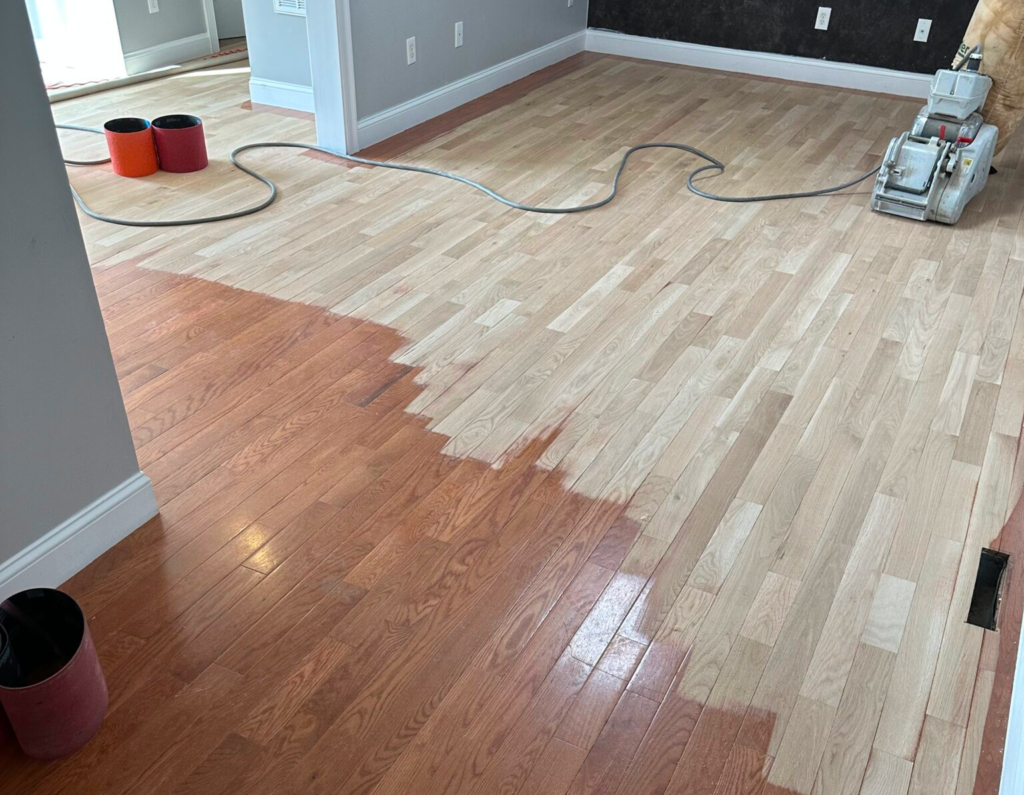
Hardwood floors are built to last — but the finish on top of them isn’t. That protective layer of polyurethane takes the daily abuse so the wood underneath doesn’t have to. Over time, it wears down, and when it does, your floors become vulnerable to moisture, dirt, and damage that can turn a simple refinishing job into a much costlier repair.
The good news is that most hardwood floors show clear warning signs before things get serious. Catching them early means the difference between a refinish that costs a few hundred dollars and a repair or replacement that costs several times more. Here’s what to look for.
The Water Drop Test: Start Here Before Anything Else
Before you inspect your floors visually, try this quick test. Find a high-traffic area — a hallway, the kitchen entrance, or anywhere that gets a lot of foot traffic — and place a few drops of water directly on the wood. Then watch what happens.
If the water beads up and sits on the surface, your finish is still doing its job. If the water soaks into the wood within a minute or two, the protective finish has worn away in that spot and your floors need attention. This simple test tells you more about the condition of your finish than anything else, and it takes about 30 seconds.
Sign 1: The Finish Looks Dull and Flat No Matter How Much You Clean
This is the most common sign and the one most homeowners notice first. Your floors look lifeless — no shine, no depth, no matter how many times you mop or polish them. Cleaning products stop making a difference because the issue isn’t dirt on the surface. The polyurethane finish has simply worn through.
Think of it like the clear coat on a car. Once it’s gone, the surface underneath starts deteriorating faster. A dull, flat appearance with no reflectivity is your floors telling you the protective layer is nearly spent and it’s time to act before the wood itself starts absorbing moisture and damage.
At this stage, a professional floor refinishing can restore the floors completely — sanding away the old finish and applying fresh coats that bring back the depth, sheen, and protection the wood needs.
Sign 2: Scratches and Scuffs Are Covering the Surface
Some surface scratches are normal and expected. Pets, furniture, dropped items — they all leave marks over time. But there’s a big difference between a few light scuffs and scratches that have worn through the finish down to the bare wood.
Here’s a quick way to tell the difference: run your fingernail perpendicular to the scratch. If your nail glides over it smoothly, it’s a surface scratch in the finish. If your nail catches in the groove, the scratch is deep enough to expose raw wood — and that exposed wood is absorbing moisture and dirt every single day.
When scratches are widespread and catching your fingernail in multiple places across the floor, refinishing is the right move. Sanding takes the surface back to bare wood, removing the scratches entirely, and fresh finish is applied over a clean, smooth surface.
Sign 3: Your Floors Are Turning Gray
If sections of your hardwood are taking on a grayish color — especially in high-traffic areas or near entryways — that’s not a sign of aging. That’s a sign of damage, and it needs to be addressed promptly.
Here’s what’s happening: when the polyurethane finish wears off completely, the bare wood fibers are exposed to oxygen and moisture. This causes the wood to oxidize, which turns it gray. Gray boards have zero protective coating, meaning every mop, every wet paw, every spill is going directly into the wood.
Left untreated, gray boards turn black — which indicates mold or rot has set in. At that point, refinishing may no longer be enough and board replacement becomes necessary. If you’re seeing gray patches, don’t wait. It’s one of the most urgent signs your floors need refinishing right away.
Not sure whether your floors can be refinished or need something more? Our guide on hardwood floor repair vs. replacement can help you figure out the right path.
Sign 4: Visible Water Stains or Dark Spots
Dark rings, black spots, or cloudy patches on your hardwood are signs that water has penetrated the wood. This can happen from pet accidents, a slow leak, spills that weren’t cleaned up quickly, or simply years of mopping with too much water.
Light water stains can often be sanded out during refinishing. Darker or more widespread staining means the moisture has gone deeper into the wood — and the sooner it’s addressed, the better the outcome. The longer water damage is left untreated, the more likely it is to lead to cupping, warping, or mold.
If you’re seeing dark spots concentrated around a particular area — under a window, near a sink, around a pet’s water bowl — identifying and fixing the moisture source is just as important as refinishing the floors.
Sign 5: Fading and Uneven Discoloration
Sunlight is one of the quieter enemies of hardwood floors. UV rays gradually bleach and fade the wood, often unevenly — areas near windows or glass doors fade faster than spots covered by rugs or furniture.
The most dramatic way to see this is to move an area rug that’s been in the same spot for years. The wood underneath has been protected from UV exposure, while everything around it has faded. That color difference can be striking.
Refinishing is the only process that can correct this. Sanding removes the faded surface layer and fresh stain is applied evenly across the whole floor, restoring a consistent, rich color throughout the room. It’s also an opportunity to update the stain color entirely if you want a different look.
Sign 6: The Wood Feels Rough, Splintery, or Uneven Underfoot
Your hardwood floors should feel smooth underfoot when you walk on them in socks. If they feel rough, gritty, or slightly fuzzy — or if you’re picking up splinters — the topcoat has deteriorated to the point where the wood fibers themselves are exposed and breaking down.
Splinters and rough patches aren’t just a cosmetic issue. They’re a safety hazard, especially for young children and pets who spend time on the floor. This is a sign that refinishing can’t be put off much longer without the risk of making things significantly worse.
Sign 7: Cupping or Slight Warping of the Boards
Cupping is when the edges of a hardwood board curl upward, creating a slightly concave surface across the plank. It happens when moisture gets underneath the boards and causes the wood to expand unevenly. You can feel it when you walk across the floor, and you can see it when light hits the surface at an angle.
Mild cupping can often be corrected through professional sanding and refinishing once the moisture source has been identified and fixed. The boards need to dry out fully first, then refinishing levels the surface and seals it against future moisture penetration.
More severe cupping — especially if the boards are also separating or buckling — may indicate a more serious moisture problem that requires hardwood floor repair beyond refinishing alone.
Sign 8: It’s Been More Than 10 Years Since the Last Refinish
Sometimes there are no dramatic warning signs — the floors just haven’t been refinished in a very long time. Most hardwood floors in average households benefit from refinishing every 7 to 10 years, depending on foot traffic, whether there are pets, and how well the floors have been maintained.
High-traffic homes — families with kids and pets, lots of entertaining — may need it closer to the 7-year mark. A single person in a low-traffic home might stretch it to 12 years or more. If you’ve moved into a home and don’t know when the floors were last refinished, the water drop test is a great starting point.
How to Know If It’s Refinishing or Replacement
Refinishing works when the wood itself is structurally sound — the issue is with the finish or surface-level damage, not the boards themselves. The floor needs to have enough wood remaining to be sanded — typically at least 3/32 of an inch of wear layer above the tongue and groove.
Replacement becomes necessary when boards are severely rotted, black from mold, broken, or when the floor has already been refinished so many times there’s no wood left to sand. If you’re not sure which situation you’re in, the best thing to do is have a professional take a look before making any decisions.
At Expert Flooring LLC, we offer free estimates and will give you a straight answer about what your floors actually need — whether that’s a full refinish, a targeted repair, or something else entirely. View our services or schedule your free estimate today and let’s get your floors back to their best.